
Elana Fertig '07
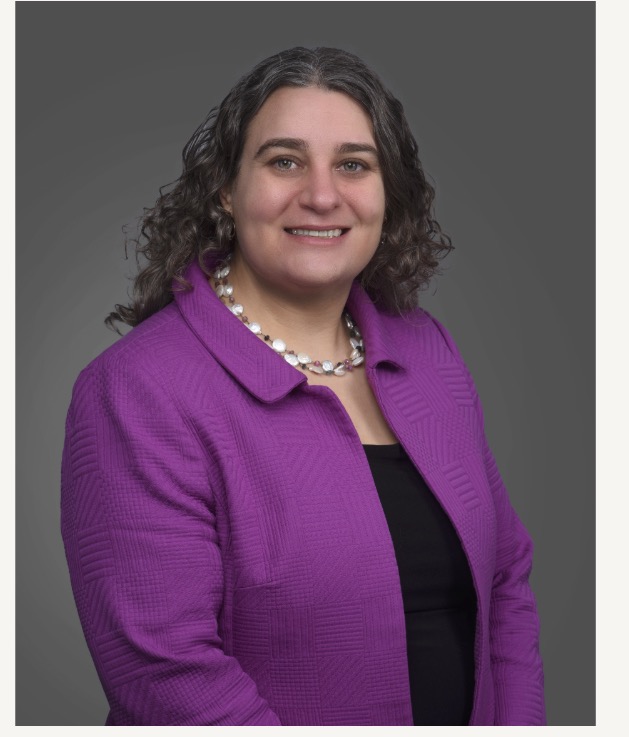 Current Position: Director, Institute for Genome Sciences and Associate Cancer Center Director for Quantitative Sciences, University of Maryland, Baltimore
PhD Dissertation Title: Assimilating Satellite Observations with a Local Ensemble Kalman Filter
PhD Advisor: Brian R. Hunt
Application Area (during AMSC studies): Numerical Weather Prediction
 What is your current position? How did you come to know about this position, and what do you like about it?
I currently direct the Institute for Genome Sciences (IGS) at the University of Maryland, Baltimore. In graduate school, I learned the power of integrating mechanistic models with high-throughput data in the context of weather prediction and sought to gain a second application area.
This led me to pursue a postdoctoral fellowship in high-throughput data integration in cancer biology. Whereas the equations of the atmosphere are known, I discovered that the equations of biological systems are not. I have been hooked by computational biology ever since.
I am excited to see how high-throughput data can advance biomedical research in my role as Director of IGS. It is also incredibly meaningful to return to the University of Maryland and contribute to training students in biomedical applications of mathematics through the AMSC program.
What are your favorite memories of your graduate school experience? What about from the AMSC program specifically?
While at AMSC, I was funded through a research fellowship from NASA Goddard. One of my favorite memories of graduate school was seeing the real-world applications of the software and algorithms we developed. It was incredibly rewarding to witness mathematical tools directly impacting scientific discovery and to see theory translated into meaningful real-world contributions.
 In what ways did the AMSC program help prepare you for your current position?
One of the most valuable aspects of AMSC was how the program taught us to abstract applied problems into mathematical frameworks while remaining deeply connected to the application domain. AMSC emphasizes working across disciplines and communicating effectively with experts in other fields. This experience empowered me to collaborate broadly throughout my career while ensuring the mathematical methods we develop can be meaningfully applied in biomedical and clinical research settings.
What advice would you give to current students?
Always seek problems that genuinely interest you and work with teams of people you enjoy collaborating with. As mathematicians, we have the unique privilege of being lifelong puzzle solvers. If you follow your curiosity, invest in collaboration, and pursue meaningful problems, the rest of your career will naturally follow.